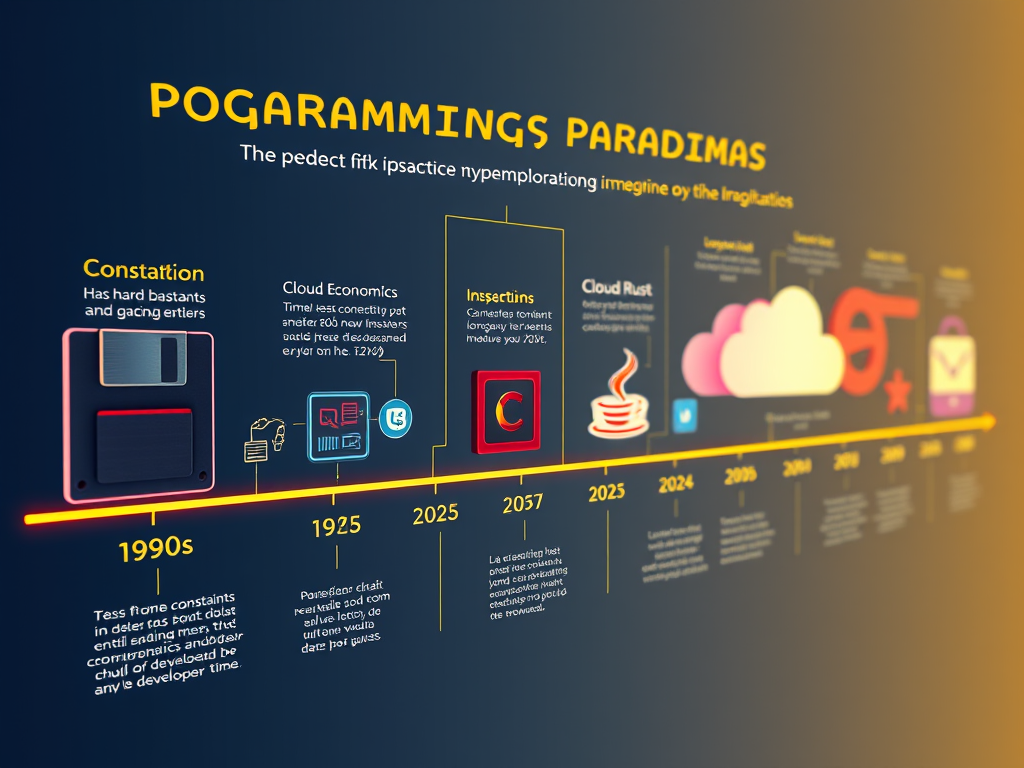
The history of programming over the last three decades is not merely a timeline of new languages, but a reflection of shifting economic constraints. In the 1990s, the most expensive resource was hardware (storage and memory), forcing developers to optimize for space. By the 2020s, the most expensive resource became developer time and system reliability, forcing a shift toward safety and abstraction.
This article explores four major tectonic shifts that have shaped modern software development:
- The Storage Inversion: A move from scarcity-driven “bit-packing” to abundance-driven “data bloat,” followed by a recent correction toward cost-optimized binary formats.
- The Safety Mandate: The transition from manual memory management (C/C++) to managed runtimes (Java) and finally to compile-time safety (Rust), largely driven by the realization that ~70% of security vulnerabilities are memory-related.
- The Database Paradigm Cycles: A pendulum swing from monolithic SQL to distributed NoSQL and back toward hybrid architectures that recapture SQL’s guarantees while maintaining scalability.
- The Great Divergence: The widening gap between “High-End” application developers (who enjoy unprecedented ease via AI and low-code tools) and “System-Side” engineers (who face exponentially growing infrastructure complexity).
Part 1: The Impact of Storage – From Floppy Disks to Cloud Economics
The cost and availability of storage have been the primary invisible hand guiding data structure design and coding styles.
The Era of Scarcity (1990s)
Constraint: Storage was physical and finite. A standard 3.5-inch floppy disk held 1.44 MB. Hard drives were measured in megabytes.
Paradigm Response: Bit-Packing and Binary Structs.
Developers used C structs with bit-fields to save individual bits. Data was serialized in raw binary formats because text-based protocols were too “heavy.”
- Example: Storing a year as “95” instead of “1995” (the root cause of Y2K) was a rational optimization when saving 2 bytes per record across millions of records meant saving expensive disk space.
- Mental Model: “Every byte counts.”
The Era of Abundance & Bloat (2005–2015)
Constraint: Storage became cheap (GBs to TBs), but network bandwidth grew slower.
Paradigm Response: Verbosity for Interoperability.
As storage costs plummeted, the industry traded efficiency for readability. XML (late 90s) and JSON (2010s) became dominant.
- Shift: A binary struct taking 4 bytes was replaced by a JSON object taking 40+ bytes:
{"id": 101} - Consequence: Developers stopped thinking about memory layout. The “store everything” mentality emerged, leading to Data Lakes where schema-less JSON blobs were dumped indiscriminately.
The Era of Cloud Economics (2015–Present)
Constraint: Storage is effectively “infinite” (S3), but access and compute costs are significant.
Paradigm Response: The Return to Binary (with a twist).
While we no longer count bits for disk space, we count them for cloud bills and I/O performance.
- Modern Optimization: We have circled back to highly efficient binary formats like Parquet and Avro, but now they are columnar and compressed for analytics rather than simple storage.
- Key Metric: The shift from “How much disk does this take?” to “How much does it cost to scan this TB of data?”
The storage constraint cycle demonstrates a fundamental truth: paradigm shifts follow economic incentives, not technological ideals.
Part 2: The Safety Revolution – Eliminating the “Billion Dollar Mistake”
For decades, the dominant paradigm (C/C++) trusted the developer completely. The shift away from this model was driven by security realities, not marketing hype.
The Raw Pointer Era (1990s)
In C and early C++, developers manually managed memory using malloc and free.
- The Risk: A developer could create a “dangling pointer” (pointing to memory that had been freed) or a “buffer overflow” (writing past the end of an array).
- The Cost: Microsoft and Google famously reported that ~70% of all severe security bugs in their history were memory safety issues.
This statistic fundamentally changed how the industry viewed memory management. If seven out of ten critical vulnerabilities stem from the same root cause—incorrect pointer handling—then the solution is not to educate developers better, but to eliminate the possibility entirely.
The Managed Runtime Reaction (2000s)
Languages like Java and C# introduced Garbage Collection (GC) as a solution.
- The Trade-off: The system manages memory for you. This eliminated many pointer errors but introduced “Stop-the-World” pauses where the software would freeze to clean up memory.
- The Paradigm: It traded control for safety. Developers could write faster, but at the cost of unpredictable latency spikes.
Java’s success in enterprise systems proved that developers would accept performance penalties in exchange for reliability. The 2000s saw an explosion of managed-language adoption, especially in backend services where predictability mattered more than raw speed.
The Modern Synthesis: Rust & Ownership (2015–2025)
The rise of Rust represents the most significant paradigm shift in system programming in 30 years.
- The Innovation: Rust uses a compile-time “Borrow Checker.” It proves—mathematically—that memory is safe before the code runs, without needing a heavy Garbage Collector.
- The Vision: You get the memory safety of Java with the performance of C++.
- Political Tipping Point: In February 2024, the White House Office of the National Cyber Director (ONCD) explicitly urged the tech industry to abandon memory-unsafe languages (like C/C++) in favor of memory-safe alternatives. This marked the end of the “raw pointer” era as a professionally acceptable default for new critical systems.
By 2025, Rust adoption in security-critical codebases (Linux kernel, Android runtime, Chrome browser) demonstrated that the paradigm shift is no longer theoretical—it’s becoming mandatory.
Memory Management Comparison
| Paradigm | Memory Management | Developer Responsibility | Primary Trade-off |
|---|---|---|---|
| C / C++ | Manual (malloc/free) | High (You control every byte) | Security vulnerabilities from pointer errors |
| Java / C# | Garbage Collection | Low (The VM handles it) | Unpredictable latency from GC pauses |
| Rust | Ownership / Borrowing | Moderate (You satisfy the compiler) | Steep learning curve during adoption |
Part 3: The Database Paradigm Cycles – SQL → NoSQL → Hybrid (NewSQL)
Database design has experienced perhaps the most dramatic reversal of any paradigm shift, driven by conflicting requirements at different scales.
The SQL Dominance (1970s–1990s)
Relational Databases emerged in the 1970s with Edgar F. Codd’s revolutionary model. By the 1990s, SQL had become the lingua franca of data storage.
- What SQL Guaranteed: ACID properties (Atomicity, Consistency, Isolation, Durability) ensured that if a transaction started, either all of it succeeded or none of it did. This was critical for financial systems and anything where partial failures were catastrophic.
- The Mental Model: “Treat the database like a single, all-knowing source of truth.”
- The Limitation: SQL databases were vertically scaled—they ran on a single, powerful machine. To handle more data, you bought a bigger server. When the internet exploded in the 1990s, this became untenable for companies like Google and Amazon.
The ACID guarantee was so powerful that no one questioned it for decades. A developer could write transactional code with the confidence that the database would never leave the system in an inconsistent state.
The NoSQL Explosion (2006–2015)
By the 2000s, Web 2.0 created an unprecedented data explosion. The internet produced unstructured and semi-structured data (photos, videos, user-generated content) that didn’t fit neatly into SQL’s rigid tables.
- What Changed: Google’s BigTable (2006) and Amazon’s Dynamo (2007) introduced NoSQL databases designed for horizontal scalability—add more servers, not bigger servers.
- The Trade-off: NoSQL databases abandoned ACID guarantees in favor of eventual consistency (BASE model). A write to one server would eventually propagate to others, but there was no guarantee it happened immediately.
- The Paradigm Shift: Developers learned to write code that could tolerate temporary data inconsistencies. Netflix stored recommendations in a NoSQL database, accepting that a recommendation seen by one user might not be seen by another for a few seconds.
- Market Reality: By 2025, NoSQL holds over 40% of the market share, demonstrating its permanent integration into the data landscape.
For the first time, scaling horizontally (adding more cheap servers) became more economical than scaling vertically (buying bigger servers). The entire database ecosystem pivoted.
The Problem with Pure NoSQL (2010s)
As companies adopted NoSQL at scale, they discovered a hidden cost: operational complexity.
- The Consistency Problem: Developers had to manually implement complex distributed consensus protocols to guarantee data integrity. What SQL did transparently, NoSQL forced developers to rewrite.
- Industry Disillusionment: In DZone’s 2020 report, many organizations who adopted NoSQL early rated their usage as “Bad” or “Very Bad,” realizing they had traded one problem (scaling limits) for another (consistency guarantees).
- The Realization: “We need both: SQL’s consistency guarantees AND NoSQL’s scalability.”
The promise of “write it once, scale it anywhere” proved more elusive than marketing suggested. Companies discovered they were paying the salary of distributed systems experts to do what SQL did for free.
The Hybrid Renaissance & NewSQL (2015–2025)
A new paradigm emerged: NewSQL databases (CockroachDB, TiDB, SingleStore) that use distributed consensus algorithms (Paxos, Raft) to provide SQL’s ACID guarantees across multiple machines.
- What NewSQL Achieves:
- Horizontal scalability (like NoSQL)
- SQL syntax and ACID transactions (like SQL)
- Strong consistency without a single point of failure
- The Synthesis: This represents the maturation of distributed systems theory. By 2025, consensus algorithms that were academic curiosities in the 1990s are now production-grade.
NewSQL doesn’t “win” the debate—it synthesizes both positions using advanced mathematics and engineering that simply wasn’t possible in earlier eras.
The Rise of File-Based and In-Memory “Helper” Databases
Alongside this SQL vs. NoSQL debate, a parallel ecosystem emerged to handle specific, high-performance use cases.
File-Based Embedded Databases (SQLite)
As mobile and IoT devices proliferated (2010s onward), developers needed databases that didn’t require a server.
- SQLite became the solution: a single C library (~30,000 lines of code) that runs directly in applications.
- Usage: By 2025, SQLite is embedded in Firefox, Chrome, iOS, Android, and airplane control systems.
- Paradigm: The inverse of the cloud—moving from “centralized data in the cloud” back to “local data on the device,” synchronized opportunistically.
SQLite’s success demonstrates that sometimes the most elegant solution is the simplest: a file on your device with a SQL interface.
In-Memory Databases (Redis, Memcached)
As the internet scaled, databases became the bottleneck. Even a database handling 5,000 queries per second would struggle if a single web service received 100,000 requests per second.
- Redis and Memcached emerged as in-memory caches that sit in front of the primary database.
- The Model: Cache frequently-accessed data in RAM. For a typical web service, 95% of reads are cache hits, reducing database load by 20x.
- Evolution: Modern Redis supports persistence, replication, and even Lua scripting, making it more than just a cache—it’s a legitimate data store in its own right.
The pattern is revealing: databases don’t disappear; they specialize. Redis isn’t replacing PostgreSQL; it’s handling a layer PostgreSQL shouldn’t handle.
Polyglot Persistence: The Acceptance of Diversity (2020–2025)
By 2025, the industry accepted a fundamental truth: no single database is optimal for all use cases.
- The Pattern: A modern application might use:
- PostgreSQL for transactional data (orders, payments) — SQL
- MongoDB for user-generated content (reviews, profiles) — Document NoSQL
- Redis for session data and caching — In-Memory Key-Value
- Elasticsearch for full-text search — Specialized NoSQL
- DuckDB for local analytics — Embedded File-Based
- The Paradigm: “Choose the right tool for each job,” rather than forcing all data into one database.
- The Cost: This flexibility comes with operational overhead—managing multiple database technologies requires specialized expertise and careful data consistency between systems.
This is no longer controversial. Companies like Uber, Netflix, and Amazon openly discuss their polyglot persistence strategies in conference talks.
Database Evolution Timeline
| Era | Primary Paradigm | Use Cases | Primary Trade-off |
|---|---|---|---|
| 1970s–1990s | SQL (Monolithic) | Financial systems, ERPs, transactional data | Cannot scale horizontally; storage-bound |
| 2006–2015 | NoSQL (Distributed) | Web scale, unstructured data, big data | No consistency guarantees; operational complexity |
| 2015–2025 | NewSQL + Polyglot | Both scale AND consistency; specialized use cases | Many moving parts; knowledge silos |
| 2020s–Present | Embedded + In-Memory Layers | Mobile, Edge, Real-time, offline-first | Data synchronization complexity |
Part 4: The Great Divergence – Ease vs. Complexity
In the 90s, a “programmer” generally understood the full stack, from the CPU register to the user interface. Today, the field has bifurcated into two distinct realities that are increasingly divergent.
The “High-End” Application Developer (The Consumer of Abstractions)
For developers building user-facing products (Web, Mobile, SaaS), life has become exponentially easier.
- Abstraction: Infrastructure is now invisible. “Serverless” platforms (like Vercel or AWS Lambda) mean developers deploy code, not servers.
- AI Assistance: Tools like GitHub Copilot act as force multipliers. A developer can now describe a function in English (“write a React component that fetches stock prices”) and receive working code in seconds.
- Database Abstraction: Object-Relational Mapping (ORM) libraries like SQLAlchemy hide database complexity behind Python objects. Developers don’t think about SQL joins; they think about object relationships.
- Standardized Patterns: The rise of frameworks (Next.js, Django, FastAPI) means most architectural decisions are already made. A developer inherits best practices by default.
- Focus: The paradigm has shifted from Implementation (how to write the loop) to Orchestration (how to glue APIs together).
The high-end developer in 2025 needs to understand their business domain, not the underlying systems.
The “System-Side” Developer (The Builder of Abstractions)
For the engineers building the clouds and platforms, the job has become significantly harder—and fewer people are willing to do it.
- The Complexity Trap: To make life simple for the app developer, the system developer must manage immense complexity. They deal with:
- Distributed Consistency: Managing state across thousands of servers (CAP Theorem) is far harder than managing state on a single 1990s mainframe. NewSQL databases embody this added complexity—the code that makes them work is orders of magnitude more sophisticated than ACID in a single-machine database.
- Hardware Heterogeneity: Modern code doesn’t just run on CPUs; it runs on GPUs, TPUs, and DPUs. Writing performant code for this “zoo” of hardware requires deep, specialized knowledge that most developers don’t have.
- The “Frankenstein” Problem: AI-generated code from app developers often creates messy, unoptimized software architectures that system engineers must debug and scale. A developer might use five third-party APIs, each with different semantics and failure modes, creating a reliability nightmare downstream.
- Database Polyglot Overhead: Supporting a polyglot persistence architecture requires maintaining expertise in SQL, NoSQL, in-memory stores, and their integration patterns—a burden that was nonexistent in the 1990s.
- Observability Overload: With microservices and distributed systems, understanding why something failed requires expertise in tracing, metrics, logs, and their correlation. A single user action might trigger 50 microservices; a single failure could originate from any one.
The Skill Bifurcation
This has created a structural problem: the cognitive load to become a system expert has doubled, while the reward structure hasn’t caught up. You must:
- Master traditional computer science (algorithms, data structures, OS design)
- Understand distributed systems theory (consensus, CAP theorem, consistency models)
- Learn multiple languages and frameworks (because different systems demand different tools)
- Maintain awareness of operations and infrastructure (containers, orchestration, observability)
Meanwhile, the application developer can use ChatGPT to write their entire service in an afternoon.
Conclusion & Outlook
The trajectory of programming paradigms has been a journey from constraint-based coding (optimizing for limited hardware) to safety-based coding (optimizing for security and reliability) to abstraction-based coding (optimizing for developer productivity).
The Database Lesson
The SQL vs. NoSQL debate illustrates a broader principle: no single paradigm is permanently optimal. As constraints shift (scalability → consistency → operational simplicity), the ideal solution changes. NewSQL databases represent maturity—they’re not “the best of both worlds” but rather the earned right to have both, achieved through sophisticated distributed systems engineering. This is the pattern: evolution doesn’t mean revolution. It means synthesizing opposing views with better technology.
The Coming Divergence
As we move toward 2030:
- Application coding will increasingly resemble product management—using natural language to direct AI agents and pre-built services. Developers will be classified by what they know about their domain, not about computers.
- System coding will become a hyper-specialized discipline (likely dominated by Rust and C++), focused on wringing performance out of expensive, specialized silicon to run those AI agents efficiently—while managing the complexity of distributed systems that span continents and data centers.
- The middle tier will disappear. There will be no more “full-stack developer.” You will either:
- Generalist orchestrator (who understands very little deeply, but can glue things together)
- Systems specialist (who understands one domain completely, but nothing else)
The 1990s programmer who understood everything is extinct. The cognitive divide is the defining feature of modern software engineering, and it will only deepen as systems become more complex and abstractions more opaque.
The real cost of these paradigm shifts isn’t measured in clock cycles or network latency. It’s measured in the concentration of expertise. Only a few thousand people on Earth truly understand how a distributed SQL database works. Only a few thousand understand Linux kernel scheduling. Only a few thousand understand GPU memory management. They are no longer fungible—they’re scarce specialists, and they know it.
This article explores how economic constraints and technological maturity have shaped programming practices over 35 years. The key insight: paradigm shifts are not about fashion or ideology—they are rational responses to changing resource scarcities and emerging technical capabilities.
Leave a Reply